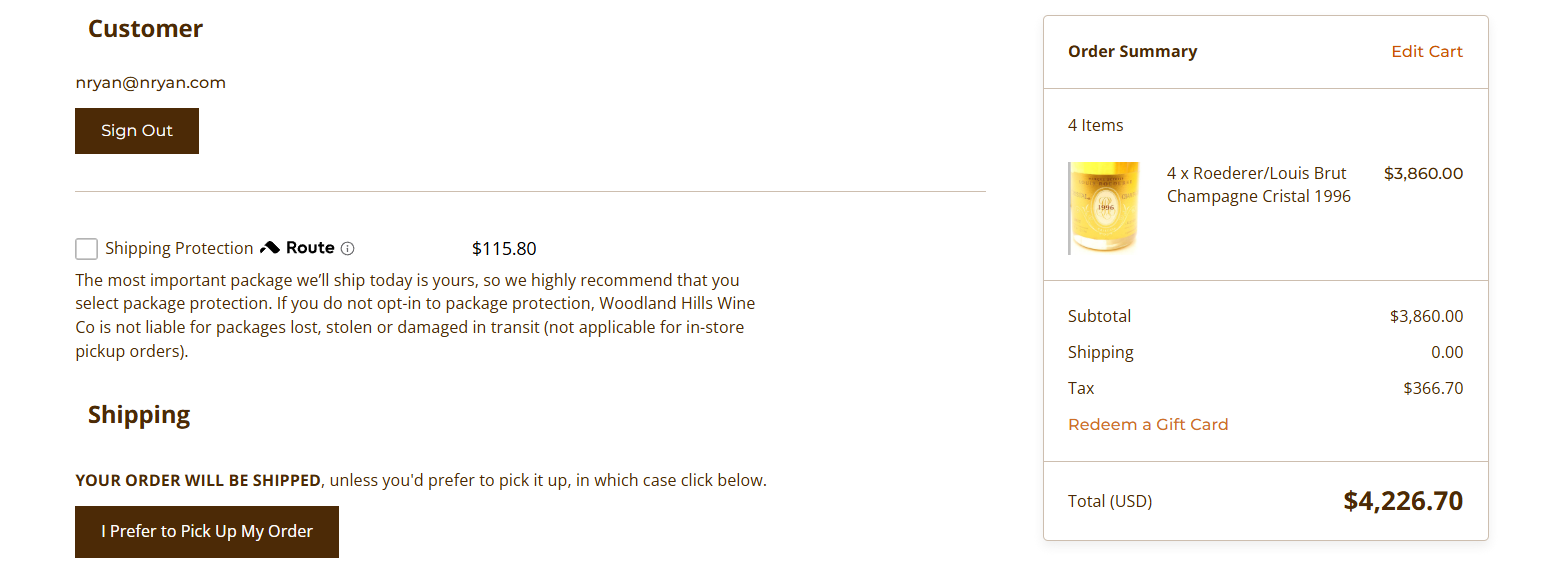
Dispute a charge for enough money, and the company can/will sue you.
Customer pays one way or the other. Either in larger margins, an explicitly broken out fee, or assumption of risk. No retail business is going to operate at a loss on purpose.
Dispute a charge for enough money, and the company can/will sue you.
Customer pays one way or the other. Either in larger margins, an explicitly broken out fee, or assumption of risk. No retail business is going to operate at a loss on purpose.
FedEx insurance can be a pretty complicated thing. One would think it would be more straightforward. FWIW, they have become much more stringent in what they will accept as proof of value. In my experience this is the most important element of any insurance/reimbursement for damage or loss. As a result, it is much easier insuring a new retail sale than something like what ANY storage company might offer as insurance. With the retail sale the receipt is handy and both sides agree on value. Conversely, if someone bought a bottle for $100 years ago and it’s worth $1,000 today and it breaks in transit even if it was insured for $1,000 the onus is on you (owner of said bottle) to prove that to FedEx. Which makes sense from their perspective since anyone could say anything. One could refer to Wine Market Journal and say this bottle hammered for $1,000 last month. Dicey if FedEx would accept that.
So the idea that FedEx insurance works the same way for all shipments is somewhat flawed. It hinges on a very good ability to prove recent value. If someone thinks there’s any doubt assume your claim will be denied.
Plus FedEx can go so far as to say the shipper did not use “FedEx approved” shipping materials and deny a claim based on that. See https://www.fedex.com/en-us/shipping/packaging/testing.html And look at what FedEx says about shipping artwork, “We recommend shipping artwork that has a lower maximum declared value and limit of liability of no greater than $1000.” https://www.fedex.com/en-us/shipping/how-to-ship-artwork.html Imagine how they feel about collectible wine.
As far as shipping insurance being a profit center that all depends on the party involved. Pointedly, their policy on “making good” with a client. Which can vary from client to client, no two clients are of the same value to a retailer. If the retailer does make good now and then it makes sense to bake a little profit into the structure to recoup that cost. Again, this is a very personal decision to each retailer.
Normally, there are handling fees and material fees associated with a shipment. The boxes don’t pack themselves. The shippers cost money as do the space to house them before usage. A person’s 6-pack shipment has to cover about $7 for the physical shipper and then whatever it takes for a guy to process the shipments for that day, say at $20/hour. Likely includes picking the order, double verification of contents, going to get the shipper, taping it all up, creating the label, loading the FedEx truck. Sounds picayune but the time spent adds up. Not even the time spent to file and follow up on a potential claim.
Again this points to normal handling fees bleeding into taking an extra point or two on things like insurance. What counts as gouging is in the eye of the beholder. Then there’s situations like that six pack gets broken. But really only one bottle broke and five are fine, just stained. Most of the time the client doesn’t want the other five bottles. FedEx is only going to pay for the one broken bottle. They are not in the aesthetics business. Who eats the “cost” of the five bottles being worth less (that is, to most people)?
Not really taking a side here. Just trying to share some experiences with the nuts and bolts of using FedEx and further how claims work in practice. To assume that insurance taken results in a successful claim is not advisable.
As a coda, there are lots of third party insurers out there. I researched this in the past. In many ways it makes business sense for the shipper to wash their hands of insurance and have a client use a third party. (In some ways this is similar to HDH and Acker auctions getting out of the fulfillment business, much less risk and downside exposure.)
https://www.pipinsure.com/
XCover - Cover Genius](XCover - Cover Genius
https://www.shipins.com/
great perspective - thanks for taking the time to write it out so well.
Actually always 2.7%, but if I’d known that pedants would complain about the difference between 2.7% and 3%… 
They charged me straight 2% on a recent order, not sure why it wasn’t 1%; it wasn’t through route.
Guy is buying $4K of wine and complaining about the insurance.
Oh brother…
Imagine creating a shopping cart but not actually buying the wine for the purposes of demonstrating how a retailer’s algorithm works. Amazing how technology works, huh?
So the question is are these sellers breaking out as optional the FedEx (or UPS) insurance as an optional item? Or are buyers getting double insured both by FedEx and the shipper of the wine?
FWIW Zachys does this too. There is an option to decline.
Forgive me but your outrage certainly implied an intended purchase.
Or are you trolling wine shop sites for reasons to complain?
There are really 2 retailers from whom I buy wines in excess of a couple hundred dollars per bottle. With them, I hold until I have at least 15 boxes (ideally more to lower the cost per bottle, but even at 10-15, it’s still much cheaper than FedEx/UPS air) and ship via Advantage or PCT with appropriate insurance. The other nice benefit is that for banded or nailed OWCs, I can keep them intact without having to unbox into shippers.
For customers to whom I sell wines, I usually advise the same for bottles in the high 3 digits into 4 digits.
@Nick_Ryan here is WHWC’s response when I asked about it:
Blockquote
Based on our experience, paying 1% for courier-provided insurance has proven to offer very limited value. At best, couriers may reimburse $100 for a lost or damaged package, even if the insurance was intended to cover a package valued at thousands of dollars. Worse yet, obtaining even that $100 reimbursement can take over a month. After facing countless claim denials from carriers over the years, we realized the need for a better solution.
Route has proven to be a far superior alternative, despite being more expensive. Claims with Route are processed and paid out within hours, not months. They reimburse the purchaser for 100% of the order value, and so far, we haven’t had a single claim denied. Payouts have been quick and hassle-free.
It’s important to note that Route is a pass-through expense—we do not profit or receive any kickback for offering their service. All monies paid for Route protection go directly to Route, enabling them to reimburse customers promptly and fully. While it is a pricier option compared to courier-provided insurance, the reliability and efficiency of Route make it a significantly better choice.
I hope this helps shed some light on our decision to offer Route package protection through our website. Please let me know if I may answer any additional questions or concerns you may have. Thank you for your inquiry and we wish you a safe and happy new year!
Sincerely,
WHWC Customer Care
They are not wrong about FedEx.
The most berserker post of the year!
My favorite PCT story, a driver drove off without closing the rear doors, we ran down the street chasing him. There was a very expensive pallet loaded last.
Other than that, seventy percent of the time I had to ask the driver to turn on the refrigeration.
Why are they charging you 1% for the $100 insurance that shippers give you?
Exactly. You get $100 for free. Their explanation makes zero sense.